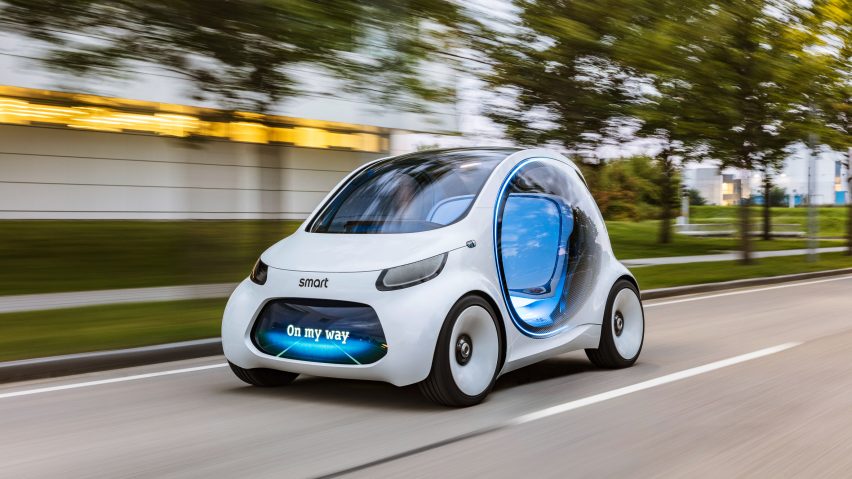
Self-driving cars (also called autonomous vehicles, AVs) are vehicles that use a combination of sensors, maps, software, and artificial intelligence to navigate roads without requiring a human driver to constantly steer, brake, or accelerate. Right now, there are real self-driving vehicles, but most are not owned by everyday drivers. Instead, companies like Waymo (originally part of Google) operate “robotaxis”, which are AVs that give rides to passengers in certain cities under tightly controlled conditions. Other companies and automakers have experimented with self-driving or advanced driver-assistance features, but as of now no mainstream automaker sells a fully autonomous personal car that will reliably drive itself in all conditions.
Though the promise of self-driving cars is appealing, there are still major hurdles. First, there is the issue of safety and reliability. Experts have raised deep concerns because computers, like humans, can still make mistakes. The perception systems (the “eyes and brain” of an AV) sometimes misinterpret or fail to identify objects. For example, failing to recognize a bicyclist or misclassifying a stationary object, and software glitches have caused AVs to behave incorrectly. In addition, AVs are often tested and operate only in limited, well-mapped and controlled areas. Their performance in complex, unpredictable, or less-studied environments (bad weather, poor lighting, chaotic traffic, unexpected pedestrians) remains uncertain. Furthermore, even when AVs perform well under certain conditions, that doesn’t guarantee they are better than human drivers in all conditions.
Experts and researchers argue that replacing humans with computers does not automatically mean fewer accidents or safer roads. Some of the most substantial risks arise from what AVs don’t do well: correctly perceiving the variety of real-world objects and situations, predicting unpredictable human behavior (like a pedestrian stepping into the street), and handling rare or unusual scenarios that are hard to train for. Also, there are ethical and liability questions: when an AV makes a mistake, who is at fault the software developer? the car manufacturer? the human (if present)? Conventional cars driven by humans will never disappear overnight, so AVs will need to safely coexist with human-driven vehicles, pedestrians, and cyclists in a complex environment that’s hard to guarantee as “safe” for everyone.
Despite the risks, self-driving technology does have strengths and design features that offer hope. Many AVs combine multiple sensors including cameras, radar, lidar (light detection and ranging), and highly detailed maps to build a detailed, 360-degree view of their surroundings. That multi-sensor approach gives them the potential to detect hazards faster than humans might. Advanced software can process sensor data, predict possible paths of moving objects, and react faster than a human might by braking or steering to avoid collisions. Also, in well-controlled conditions (good weather, good roads, known routes), some AVs may reduce certain types of non-fatal accidents compared to human drivers.
Self-driving cars have enormous potential. If perfected and combined with clean electric power, they could offer easier, more “hands-free” transportation, useful for people who can’t drive (elderly, disabled, or too young), or who don’t own a car. They might reduce driving stress, make commuting more efficient, and — if widely adopted and shared — reduce emissions and congestion. But because the risks are real and potentially serious, we must improve these systems carefully. That means continuing to train and refine the AI so it can better read roads, pedestrians, unpredictable situations, and also making sure a human driver can take control when needed, at least until autonomous systems are proven safe under all conditions. In short: AI + human backup = safer path forward. We should also pair self-driving technology with policies that support electric vehicles, data-sharing standards, and ethical rules to protect passengers, pedestrians, and society.
Self-driving cars are no longer science fiction, they exist today in limited forms, and they hold great promise for transforming transportation, reducing emissions, and making travel easier for many people. But the technology is not yet flawless. Mistakes by sensors or software, unpredictable road conditions, and moral or liability questions mean that AVs are not ready to fully replace human drivers. The best way forward is not to rush full automation, but to keep improving the AI while allowing human drivers to remain ready to intervene when complexity arises. Over time, with better design, testing, and regulation, paired with ethical and environmental policies, self-driving cars could become a safer, cleaner, and more accessible way for our communities to travel.
References
Union of Concerned Scientists. (n.d.). Self-driving cars 101. https://www.ucs.org/resources/self-driving-cars-101
MacCarthy, M. (2024). The evolving safety and policy challenges of self-driving cars. https://www.brookings.edu/articles/the-evolving-safety-and-policy-challenges-of-self-driving-cars/
Harvard Business School. (n.d.). Why people blame self-driving cars more than human drivers. https://www.library.hbs.edu/working-knowledge/why-people-blame-self-driving-cars-more-than-human-drivers
Acheampong, R., Cugurullo, F., & Gueriau, M. (2022). Autonomous vehicles and the city: A comprehensive review. Sustainability, 14(3), 1–29. https://pmc.ncbi.nlm.nih.gov/articles/PMC8885781/
Badue, C., Guidolini, R., Carneiro, R., et al. (2021). Self-driving cars: A survey. Expert Systems with Applications, 165, 113816. https://www.sciencedirect.com/science/article/pii/S2352146520300995